
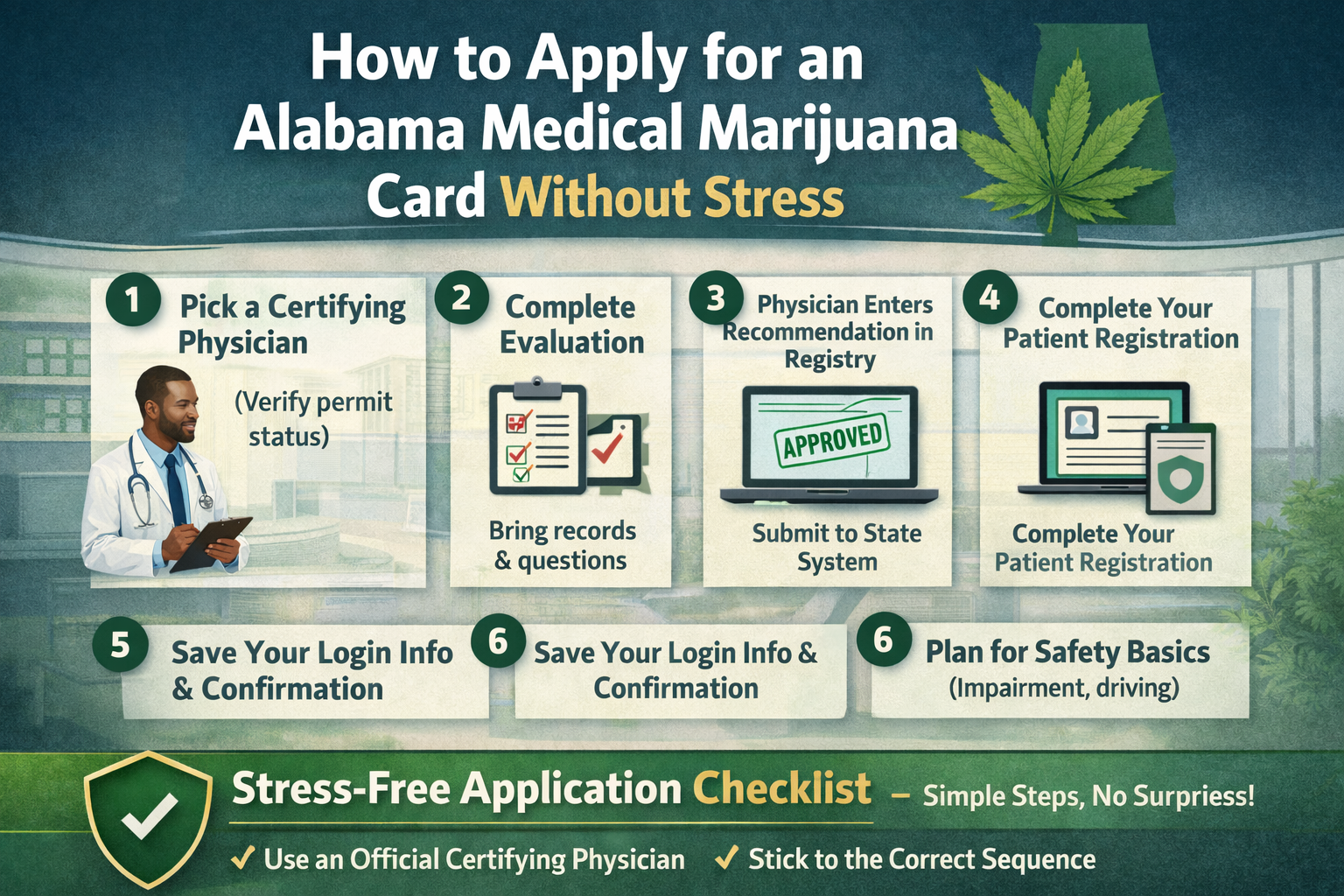
How to Apply for an Alabama Medical Marijuana Card Without Stress
Applying for an Alabama marijuana card doesn’t have to feel confusing, intimidating, or time-consuming. The “stress” usually comes from three things: not knowing the exact order of steps, not having the right documents ready, or working with a clinic that doesn’t explain what happens next.
This guide lays out a calm, step-by-step path so you can move through the process confidently—without rushing, guessing, or getting stuck.
Step 1: Understand what actually starts your application
In Alabama, the process doesn’t start with a dispensary or a website form—it starts with a registered certifying physician who evaluates you and (if appropriate) enters your recommendation into the patient registry system. The Alabama Medical Cannabis Commission (AMCC) explains it plainly: you must be diagnosed with a qualifying condition by a registered certifying physician, and if medical cannabis is recommended, the physician enters your info and recommendation into the registry—then you can complete patient registration and apply for a card.
Stress-free mindset shift:
You’re not “applying blind.” You’re following a sequence:
- physician evaluation → 2) registry entry → 3) patient registration/card application.
Step 2: Find a legitimate certifying physician (and verify them)
A simple way to reduce stress is to verify the physician is actually listed as a medical cannabis certifying physician in Alabama. The Alabama Board of Medical Examiners (ALBME) provides a way to locate certifying physicians through its license lookup instructions.
Helpful resource (hyperlink #1):
Tip: If a clinic can’t clearly explain how they certify patients or avoids questions about the registry, pick a different provider.
Step 3: Gather your “no-stress” appointment checklist
You don’t need a giant folder of paperwork, but you do want enough information to make your evaluation smooth.
Bring:
- A brief list of symptoms (how long, how severe, how they affect daily life)
- Treatments you’ve already tried (meds, therapy, etc.)
- Any relevant records (diagnosis paperwork, recent visit notes—if available)
- Your current medication/supplement list
- Questions you want answered (product types, safety, follow-ups)
Why this helps: it shortens the back-and-forth and helps the physician document your case appropriately.
Step 4: What happens during the evaluation (and why it matters)
A real evaluation should feel like healthcare—not a “rubber stamp.” The physician should review your history, confirm your condition, and make a clinical judgment about whether medical cannabis is appropriate for you.
If the physician recommends medical cannabis, they take the key behind-the-scenes step: entering your information and recommendation into the AMCC patient registry system, which then makes you eligible to complete your patient registration and apply for Alabama Medical Marijuana Cards.
Helpful resource (hyperlink #2):
Step 5: Know what information may be required in the registry
One of the biggest “surprise stressors” is not realizing what information may be collected for the registry/card process. ALBME outlines categories of information that must be submitted to the registry (such as patient identifying details and, when applicable, caregiver/guardian information).
Helpful resource (hyperlink #3):
Pro tip: If you may need a caregiver, ask the clinic early so you don’t hit paperwork delays later.
Step 6: Complete your patient registration and card application (the “no panic” way)
Once your physician has entered your recommendation into the registry, you can complete the patient registration and apply for your card. AMCC’s FAQ explains the sequence from physician recommendation → registry entry → patient registration/application.
Helpful resource (hyperlink #4):
How to keep this step stress-free:
- Do it when you have 20–30 minutes uninterrupted
- Double-check spelling of your legal name and key identifiers
- Take screenshots/notes of confirmation screens (for your own records)
Step 7: Avoid the most common “stress traps”
These are the issues that most often slow people down:
1) Assuming you can apply without a certifying physician
You generally can’t. The registry entry is tied to the physician recommendation.
2) Choosing a clinic that doesn’t explain next steps
A good clinic will tell you exactly what happens after the evaluation.
3) Waiting until the last minute to gather documentation
If you have records, great—bring them. If you don’t, still go, but be prepared to describe your history clearly.
4) Not planning for safety basics
Even after you receive an Alabama marijuana card, you’ll want to follow medical guidance and safety rules—especially around impairment and driving. The CDC advises the safest option is not to drive after using cannabis, and outlines prevention steps for impaired driving.
A simple “zero-stress” timeline you can follow
Use this as your mental map:
- Pick a certifying physician (verify licensing/permit status)
- Complete your evaluation and ask questions
- Physician enters recommendation into registry
- You complete patient registration + card application
- Keep your info saved (login details, confirmation messages, dates for renewal reminders)
Final takeaway
The easiest way to apply for Alabama Medical Marijuana Cards without stress is to follow the correct order and use official resources: start with a verified certifying physician, show up prepared, let the physician enter your recommendation in the registry, then complete your patient registration and card application carefully.