
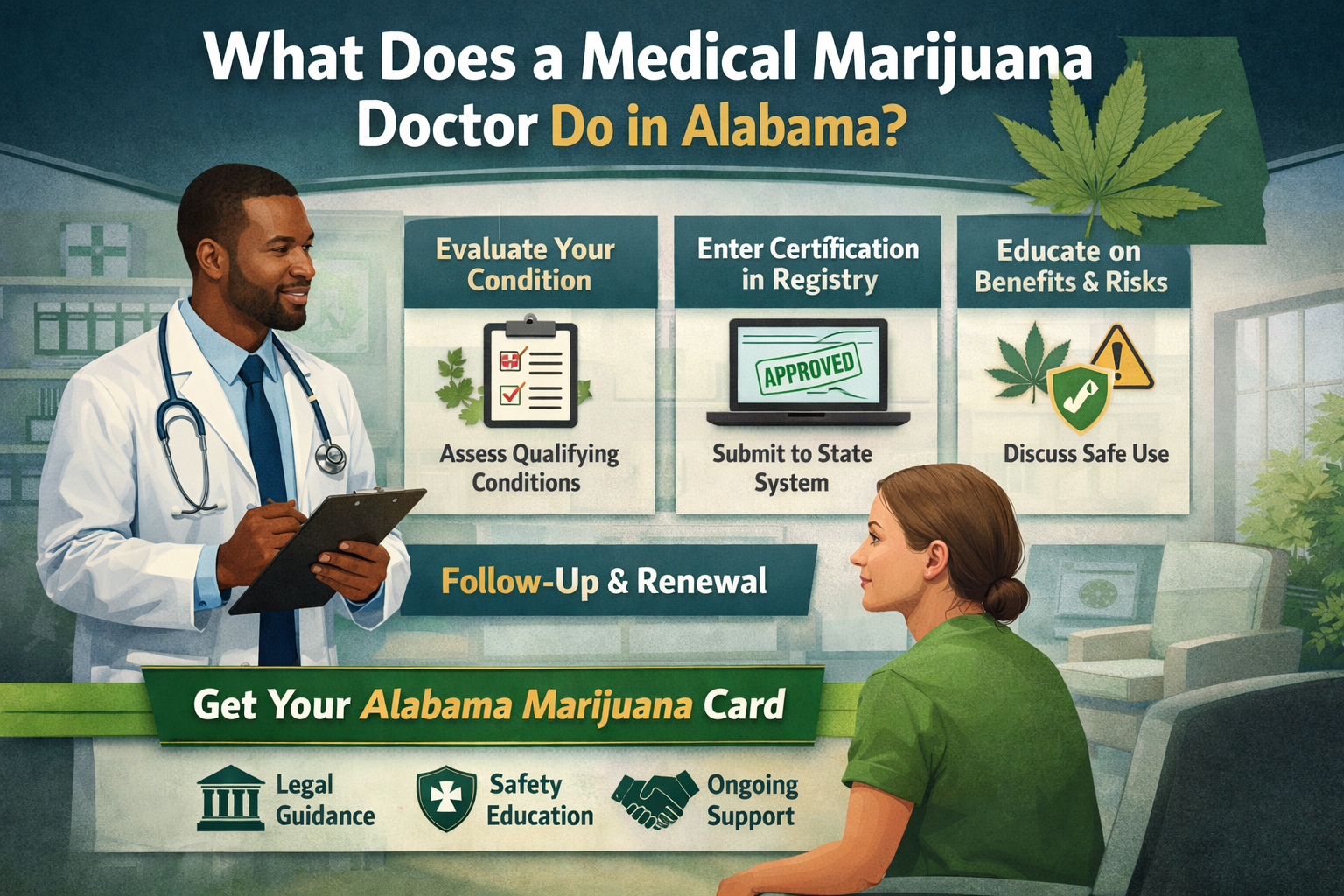
What Does a Medical Marijuana Doctor Do in Alabama?
If you’re thinking about medical cannabis in Alabama, the “medical marijuana doctor” is the gatekeeper who helps determine whether you qualify, documents your condition, and (when appropriate) enters a recommendation into the state system so you can move forward with an Alabama marijuana card. They also play a big role in education—helping patients understand potential benefits, risks, and how to use products responsibly within Alabama’s rules.
This guide breaks down what these doctors actually do, what they don’t do, and what you should expect from an appointment.
Quick note: This article is educational and not medical or legal advice. Always follow your clinician’s guidance and Alabama regulations.
1) They confirm you’re seeing the right kind of doctor for Alabama’s program
In Alabama, not every physician can recommend medical cannabis. The state requires that a physician be properly qualified/registered as a certifying physician for the program. The best starting point is the official patient/physician guidance from the Alabama Medical Cannabis Commission, which explains how the physician side works and where patients fit into the registry process:
If a clinic advertises medical cannabis evaluations, it’s still smart to confirm they’re following the required steps and using the appropriate registry pathway.
2) They evaluate your condition and medical history (not just “rubber-stamp” a card)
A legit Alabama medical cannabis evaluation should look and feel like a real medical visit. Your doctor typically:
- Reviews your symptoms and how long they’ve been present
- Goes over prior treatments you’ve tried (and what worked or didn’t)
- Reviews relevant medical records (when needed)
- Screens for safety concerns (like medication interactions, mental health considerations, substance-use risk, pregnancy, or cardiovascular risk factors)
- Explains realistic expectations—what medical cannabis may help with and what it may not
This matters because Alabama’s rules tie certification to a documented qualifying condition and a physician’s clinical judgment—not a quick online form with no context. Alabama law describes physician responsibilities around diagnosing/confirming qualifying conditions and the certification process.
3) They explain what “recommendation” means in Alabama (and what it doesn’t)
A common misconception is that a medical cannabis doctor “prescribes” marijuana like an antibiotic. In practice, medical cannabis programs use a certification/recommendation model with specific documentation and registry steps.
So what does the Alabama doctor do?
- Determines whether you qualify under Alabama’s program rules
- If appropriate, completes the certification steps required by the state framework
- Enters the needed information into the patient registry system so you can apply for your card
What they don’t do:
- They typically can’t treat this like a standard retail “dispensary recommendation” with zero follow-up
- They shouldn’t guarantee approval for an Alabama Medical Marijuana Cards application before evaluating you
- They don’t override state product restrictions or program rules
4) They enter your recommendation into the state registry so you can apply for a card
If the doctor determines medical cannabis is appropriate, they take a key step many patients don’t see: they input your information and recommendation into Alabama’s registry process, which then allows you to complete your patient registration and apply for a card.
The certification/registry process also connects to requirements maintained through the Alabama Board of Medical Examiners, which outlines what information is submitted and how physician registration for medical cannabis works in Alabama:
This step is one of the biggest reasons you want a reputable clinic: if the registry information is incomplete or incorrect, it can delay your progress.
5) They educate you on safe, responsible use (benefits, risks, and expectations)
A good Alabama medical cannabis doctor will spend time on education, including:
Potential benefits (condition-dependent)
Some patients seek cannabis for symptom relief—often when other treatments haven’t provided enough improvement. Your doctor should keep expectations grounded and explain that response varies by person, product type, and dosing approach.
Risks and safety considerations
Medical cannabis can come with real risks (including impairment, dependency risk, mental health impacts for some people, and potential negative outcomes depending on your health profile). The Centers for Disease Control and Prevention summarizes known health effects and risks here:
Practical guardrails
Doctors commonly advise patients on:
- Avoiding driving or operating machinery while impaired
- Starting with low amounts and adjusting cautiously (a “start low, go slow” approach—when appropriate)
- Watching for side effects and stopping/adjusting if needed
- Keeping products secured away from children and pets
This education piece is a core part of what a medical marijuana doctor should do—especially for first-time patients pursuing an Alabama marijuana card.
6) They handle follow-ups, renewals, and ongoing monitoring when appropriate
For many patients, certification isn’t a one-and-done event. Depending on the clinic and your needs, follow-up may include:
- Monitoring symptom changes and side effects
- Updating your medical records when needed
- Helping with recertification/renewal timing and any required steps
- Reviewing changes in medications or health conditions
Even if follow-up is brief, it’s an important layer of patient safety and accountability—especially because tolerance, side effects, and symptom patterns can change over time.
7) They help you understand caregiver/minor requirements and documentation
Some patients (especially minors or people who need assistance) may need a caregiver arrangement as part of the state framework. A medical cannabis doctor (or the clinic’s staff) typically explains what documentation is needed and how caregiver registration works in the process.
Because program details can be technical, the safest approach is to rely on official program sources and a clinic that clearly walks you through each step without rushing.
8) What to expect at your appointment (simple checklist)
To make your visit smoother, show up with:
- A brief timeline of your symptoms (when it started, how it affects daily life)
- A list of current medications/supplements
- Any relevant diagnosis paperwork or supporting medical records (if you have them)
- Notes on prior treatments you’ve tried (PT, medications, counseling, etc.)
- Questions you want answered (effects, risks, follow-up cadence, cost, timeline)
A quality clinic will take the time to review, explain, and document appropriately—so you’re not left guessing what happens next for your Alabama Medical Marijuana Cards application.
Final takeaway
In Alabama, a medical marijuana doctor’s job is much more than “signing paperwork.” They evaluate whether you qualify, document your condition, educate you on risks and responsible use, and—if appropriate—enter your certification into the registry so you can proceed with an Alabama marijuana card.
If you want the most reliable experience, use official Alabama program resources, ask good questions, and choose a clinic that treats this like healthcare—not a shortcut.
Helpful official resources (linked above in the article):
- AMCC program overview (patients/physicians)
- ALBME medical cannabis registration details
- Alabama Medical Cannabis Statute (for legal framework)
- CDC cannabis health effects (for safety/risk education)
Outbound resource included in this article (legal text):