
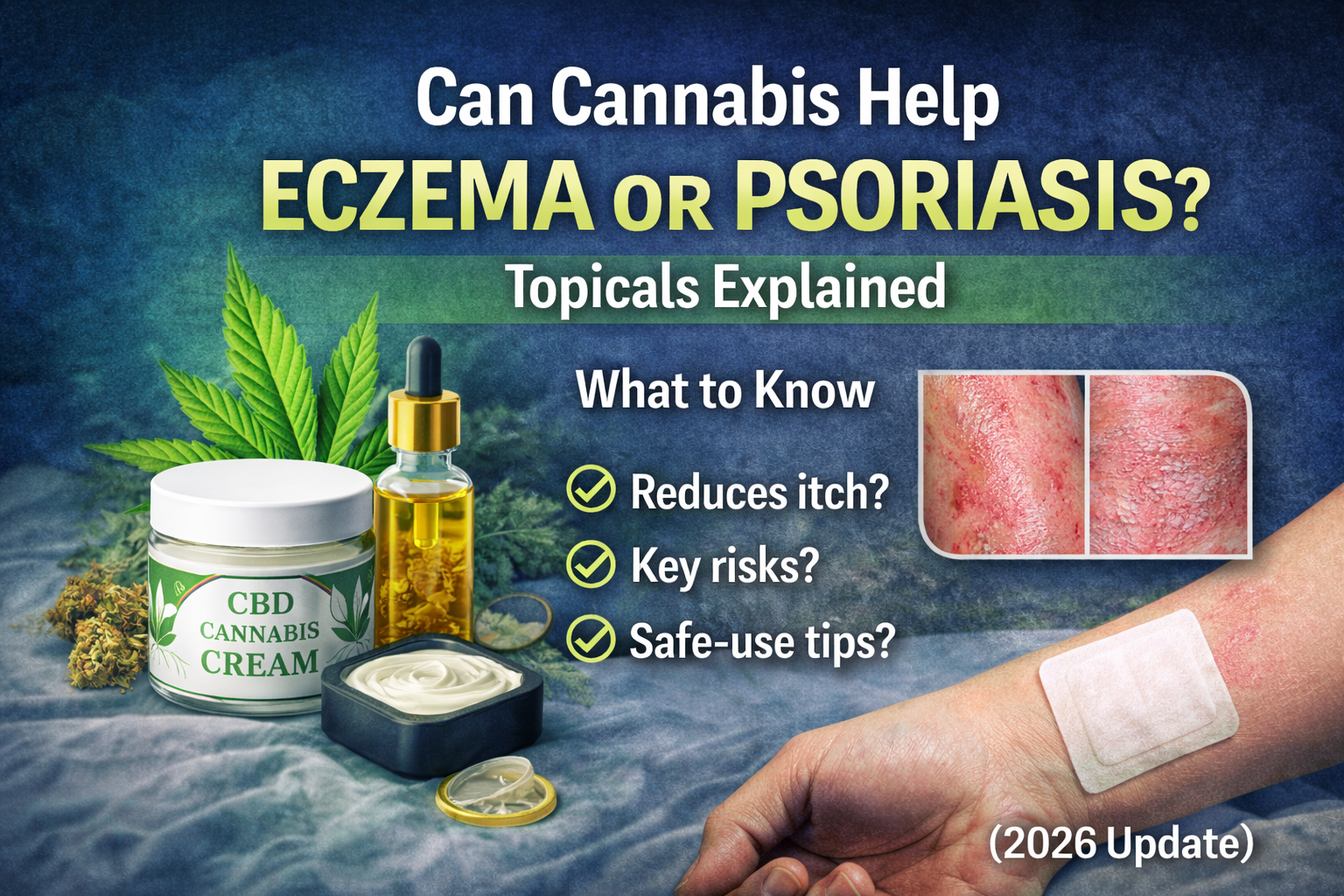
Can Cannabis Help With Eczema or Psoriasis? (Topicals Explained)
If you’ve ever dealt with eczema (often atopic dermatitis) or psoriasis, you already know how disruptive flare-ups can be—itching, redness, scaling, cracked skin, and that constant cycle of “better… then worse again.” With so many people searching for gentler options, cannabis topicals (especially CBD creams and ointments) have become a hot topic.
So, can cannabis actually help eczema or psoriasis? The research suggests topical cannabinoids may help certain symptoms—especially itching and inflammation—for some people, but the evidence is still developing, product quality varies widely, and they shouldn’t replace proven first-line treatments without a clinician’s guidance.
And if you’re in Alabama and exploring an Alabama marijuana card or learning how Alabama Medical Marijuana Cards work, topicals often come up in patient questions—especially for people looking for non-smokable, skin-focused options.
Below is a clear breakdown of what topicals are, what studies say, what can backfire, and how to use them more safely.
First: Eczema vs. Psoriasis (why it matters)
These conditions can look similar but behave differently:
- Eczema (atopic dermatitis) is often driven by skin barrier dysfunction, immune activity, and triggers like irritants, allergens, stress, sweating, and weather changes.
- Psoriasis is an immune-mediated inflammatory condition that speeds up skin cell turnover, causing thick plaques and scaling, often on elbows, knees, scalp, and lower back.
Because the biology isn’t identical, a topical that helps itch in eczema might not meaningfully reduce plaque thickness in psoriasis—or vice versa.
What are “cannabis topicals,” exactly?
Cannabis topicals are products applied to the skin—usually creams, lotions, salves, balms, or ointments—that contain cannabinoids like:
- CBD (cannabidiol) (non-intoxicating)
- THC (delta-9-tetrahydrocannabinol) (intoxicating when absorbed systemically, though typical topical use is less likely to cause a “high” compared to inhaled/oral forms)
- Other cannabinoids (CBG, etc.)
Topical vs. transdermal: not the same
- Topical products are generally intended for local effects on the skin (itch, redness, irritation).
- Transdermal products (patches, some gels) are designed to cross the skin barrier into the bloodstream more efficiently.
Most over-the-counter “CBD creams” are topical, not truly transdermal.
What the research says so far (the realistic takeaway)
1) Symptom relief may be most noticeable for itch
A 2025 systematic review on cannabinoids in dermatology reported a modest but statistically significant reduction in pruritus (itch), but found no significant benefits for other dermatologic outcomes overall—highlighting the need for larger, standardized trials.
Here’s a good overview source: Cannabis and cannabinoids in dermatology (systematic review)
What that means in plain English: If topicals help, the biggest “win” may be less itching, rather than a dramatic change in rash or plaque severity.
2) Eczema (atopic dermatitis): promising theory + early evidence, but not definitive
The National Eczema Association describes topical CBD as “promising in theory” for itch, pain, inflammation, and barrier support—but emphasizes the need for more research and cautions about product quality and claims.
Helpful reference: National Eczema Association: Get the Facts—CBD
Reality check: Many reports are small studies or observational findings. Some people improve, others don’t notice much, and irritation can happen depending on the formula.
3) Psoriasis: potential anti-inflammatory mechanisms, mixed clinical results
Psoriasis research includes lab and early clinical signals suggesting cannabinoids might influence inflammation and skin cell behavior, but human outcomes aren’t yet consistent enough to call topicals a primary psoriasis therapy. The American Academy of Dermatology maintains evidence-based psoriasis guidelines for topical management and complementary approaches, which is a good “grounding” reference for what’s proven.
Reference: AAD: Psoriasis clinical guideline
4) Patient-education perspective: cannabinoids may help, but don’t replace standard care
The National Psoriasis Foundation discusses cannabis/CBD as something patients ask about and notes potential anti-inflammatory effects, while still framing it as an area where more clinical evidence is needed.
Reference: National Psoriasis Foundation: Cannabis, marijuana, pot, or weed
How cannabis topicals might work on skin
Researchers think cannabinoids may influence the skin through the body’s endocannabinoid system, which is involved in:
- Inflammation signaling
- Itch pathways
- Skin barrier regulation
- Immune cell activity in skin
In practice, that could translate into:
- Less itching
- Reduced redness or irritation for some users
- Improved comfort during flare-ups
But the effect depends on a lot: concentration, formulation, other ingredients, and your specific skin biology.
Where topicals can backfire
Even if cannabinoids themselves are well-tolerated, topical products can cause problems due to what’s around them:
1) Irritation from fragrances, essential oils, or harsh preservatives
Many “CBD creams” include ingredients that are common irritants for eczema-prone skin (fragrance is a big one). For eczema especially, the wrong vehicle can worsen burning, stinging, and flare-ups.
2) Allergic contact dermatitis
Botanicals, carrier oils, and even “natural” ingredients can trigger allergic reactions. If you notice worsening redness, swelling, or rash spread, stop and consult a clinician.
3) Inconsistent labeling and quality
The topical market is crowded, and cannabinoid content may vary. That’s why it’s smart to choose products with transparent testing and simple ingredient lists.
4) Using topicals as a replacement for proven therapy
For psoriasis, skipping proven treatments can lead to worsening plaques, cracking/bleeding skin, or infections. For eczema, undertreating inflammation can keep the itch-scratch cycle alive.
Practical “topicals explained” tips (safer-use approach)
If you’re considering a cannabinoid topical for eczema or psoriasis, these are reasonable best practices to discuss with your clinician:
- Patch test first: Apply a small amount to a limited area for 24–48 hours.
- Choose simple formulations: Fragrance-free, minimal ingredient list (especially for eczema).
- Avoid broken skin unless your clinician says otherwise: Open cracks can increase irritation and absorption.
- Use it as an add-on, not a replacement: Especially if you’re on a dermatologist-guided regimen.
- Track results: itch level, redness, scaling, sleep disruption, and how quickly flares calm down.
Alabama note: where “Alabama Medical Marijuana Cards” fit in
People pursuing an Alabama marijuana card often ask about non-inhaled options, including topicals. While topicals may feel “low risk,” they still deserve thoughtful use—especially because eczema and psoriasis can overlap with infection risk, medication interactions, and other skin conditions that look similar.
If you’re considering Alabama Medical Marijuana Cards, the most sensible path is:
- confirm your diagnosis (eczema vs psoriasis vs something else),
- ask your clinician how cannabinoids fit (if at all), and
- keep proven treatments on board while you evaluate add-ons.
Bottom line
Cannabis topicals may help some people with eczema or psoriasis—most notably by reducing itch and discomfort—but the evidence isn’t strong enough to treat them as a primary therapy. Product quality and formulation matter a lot, and irritation is a real possibility, especially for sensitive eczema skin.
If you’re curious, approach it like a careful experiment: patch test, pick a gentle formula, track symptoms, and talk with a clinician—particularly if you’re navigating an Alabama marijuana card process or researching Alabama Medical Marijuana Cards.
Medical disclaimer: This content is educational and not medical advice. Talk with a licensed healthcare professional or dermatologist for personalized guidance, especially if you have severe flares, signs of infection, or are pregnant/breastfeeding.