
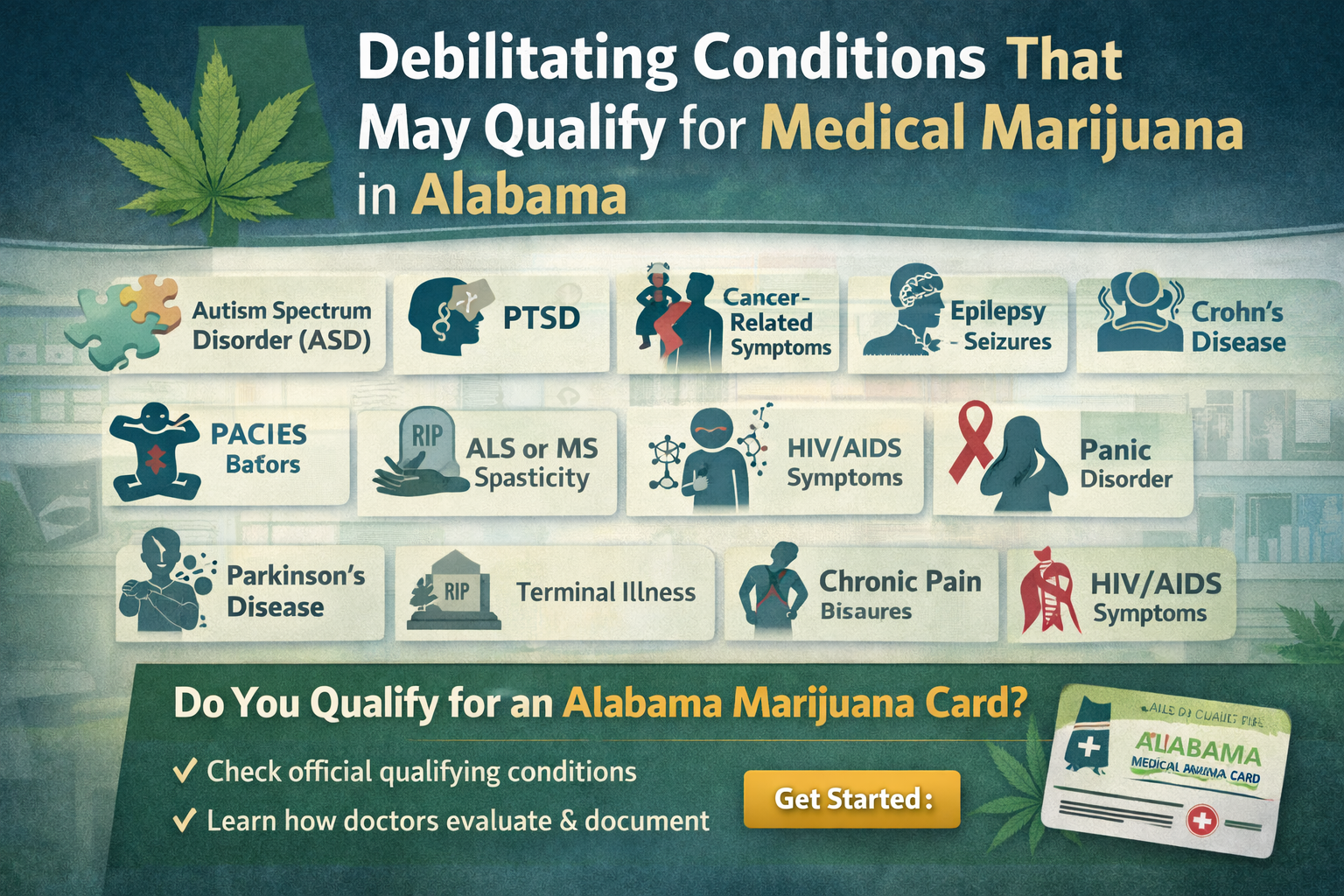
Debilitating Conditions That May Qualify for Medical Marijuana in Alabama
If you’re exploring an Alabama marijuana card, one of the first questions is always the same: “Do I actually qualify?” In Alabama, the answer depends on two things:
- Whether you have a qualifying medical condition recognized by the state, and
- Whether a registered certifying physician determines medical cannabis is appropriate for you based on your history, current symptoms, and treatment response.
Below is a clear, patient-friendly guide to the debilitating (qualifying) conditions that may qualify you for Alabama Medical Marijuana Cards, plus practical tips on what doctors look for and how to prepare.
Who decides if you qualify?
Alabama’s list of qualifying conditions is set by state law and program rules, and it’s referenced by official state agencies like the Alabama Medical Cannabis Commission and the Alabama Board of Medical Examiners.
Even if you have a condition on the list, a physician still evaluates whether cannabis is appropriate and safe for you—including reviewing what you’ve tried already, your medication history, and any contraindications.
Alabama qualifying conditions (what the state recognizes)
Here are the qualifying conditions Alabama lists through official program guidance and physician rules.
1) Autism / Autism Spectrum Disorder (ASD)
Medical cannabis may be considered for certain symptoms when clinically appropriate. Documentation and symptom history matter, especially if the patient is a minor (THC limits for minors may apply).
2) Cancer-related cachexia, nausea/vomiting, weight loss, or chronic pain
This category covers cancer-related symptom burdens that can be debilitating—like severe appetite/weight issues, nausea, or pain related to cancer or its treatment.
3) Crohn’s Disease
Crohn’s can cause chronic inflammation, severe abdominal pain, and significant quality-of-life disruption. Alabama includes it as a qualifying condition.
4) Depression
Depression is listed as a qualifying condition in Alabama. Because cannabis can affect mood and cognition, certifying physicians often evaluate mental-health history carefully before recommending it.
5) Epilepsy or a condition causing seizures
This includes epilepsy and seizure disorders. Your doctor may ask for diagnosis records, medication history, and seizure frequency details.
6) HIV/AIDS-related nausea or weight loss
For people living with HIV/AIDS, nausea and weight loss can be severe and persistent. Alabama recognizes these symptom burdens.
7) Panic disorder
Panic disorder is listed as qualifying. Because THC can worsen anxiety in some people, doctors typically discuss risk/benefit carefully and may emphasize cautious dosing strategies (when appropriate).
8) Parkinson’s disease
Parkinson’s is included as a qualifying condition, particularly where symptoms significantly affect daily functioning.
9) Persistent nausea not related to pregnancy
Alabama specifies persistent nausea not significantly responsive to traditional treatment, with exclusions such as pregnancy-related nausea and certain cannabis-induced vomiting conditions.
10) PTSD (Post-Traumatic Stress Disorder)
PTSD is a qualifying condition. Many clinics will want documentation of diagnosis and current treatment history (therapy, medications, etc.).
11) Sickle Cell Anemia
Sickle cell is included due to the potential for severe pain crises and significant impairment.
12) Spasticity associated with ALS (motor neuron disease)
Spasticity tied to motor neuron disease (including ALS) is listed as qualifying.
13) Spasticity associated with Multiple Sclerosis (MS) or spinal cord injury
MS- or spinal-cord-injury-related spasticity is also explicitly included.
14) A terminal illness
Terminal illness qualifies, and dosage/administration considerations may differ for end-of-life care under program rules.
15) Tourette’s Syndrome
Tourette’s is included as a qualifying condition.
16) Chronic pain (when conventional options are ineffective or not appropriate)
Alabama also recognizes chronic or intractable pain in specific circumstances—generally when conventional therapeutic interventions are contraindicated or have proved ineffective (and AMCC also references chronic pain where conventional therapies/opioids shouldn’t be used or don’t work).
What doctors typically look for (so you don’t get stuck)
Even when your condition is on the list, physicians usually need enough clinical context to make a safe recommendation and document it properly. In Alabama, physician rules describe medical-record expectations such as documenting the qualifying condition, reviewing prior treatments, and establishing an in-person physician–patient relationship.
Here’s what helps your visit go smoothly:
- Clear diagnosis history: When were you diagnosed? By whom?
- Symptom impact: How does it affect sleep, work, daily function, pain levels, appetite, etc.?
- Treatment attempts: What have you tried (medications, PT, therapy, procedures), and what happened?
- Medication list: Include prescriptions + OTC + supplements.
- Safety factors: History of substance use disorder, pregnancy status (if applicable), and mental-health considerations may be reviewed.
Important safety reality check (still stress-reducing)
A low-stress application is not just about paperwork—it’s also about understanding risks and having realistic expectations. The Centers for Disease Control and Prevention summarizes cannabis health effects and notes evidence varies depending on the condition and product type.
And the U.S. Food and Drug Administration explains how cannabis and cannabis-derived products are regulated (and what is/isn’t FDA-approved), which is useful context for patients exploring medical use.
Want the simplest way to check your condition?
For a quick, patient-friendly overview you can share with your team or patients, here’s your qualifying conditions page (inbound link):
Outbound resources (4 supporting links)
These are reputable sources that back up the condition list and key program details:
- AMCC – What conditions qualify for medical cannabis treatment?
- ALBME – Medical Cannabis (qualifying conditions + physician requirements)
- CDC – Cannabis and Chronic Pain
- FDA – Regulation of Cannabis and Cannabis-Derived Products