
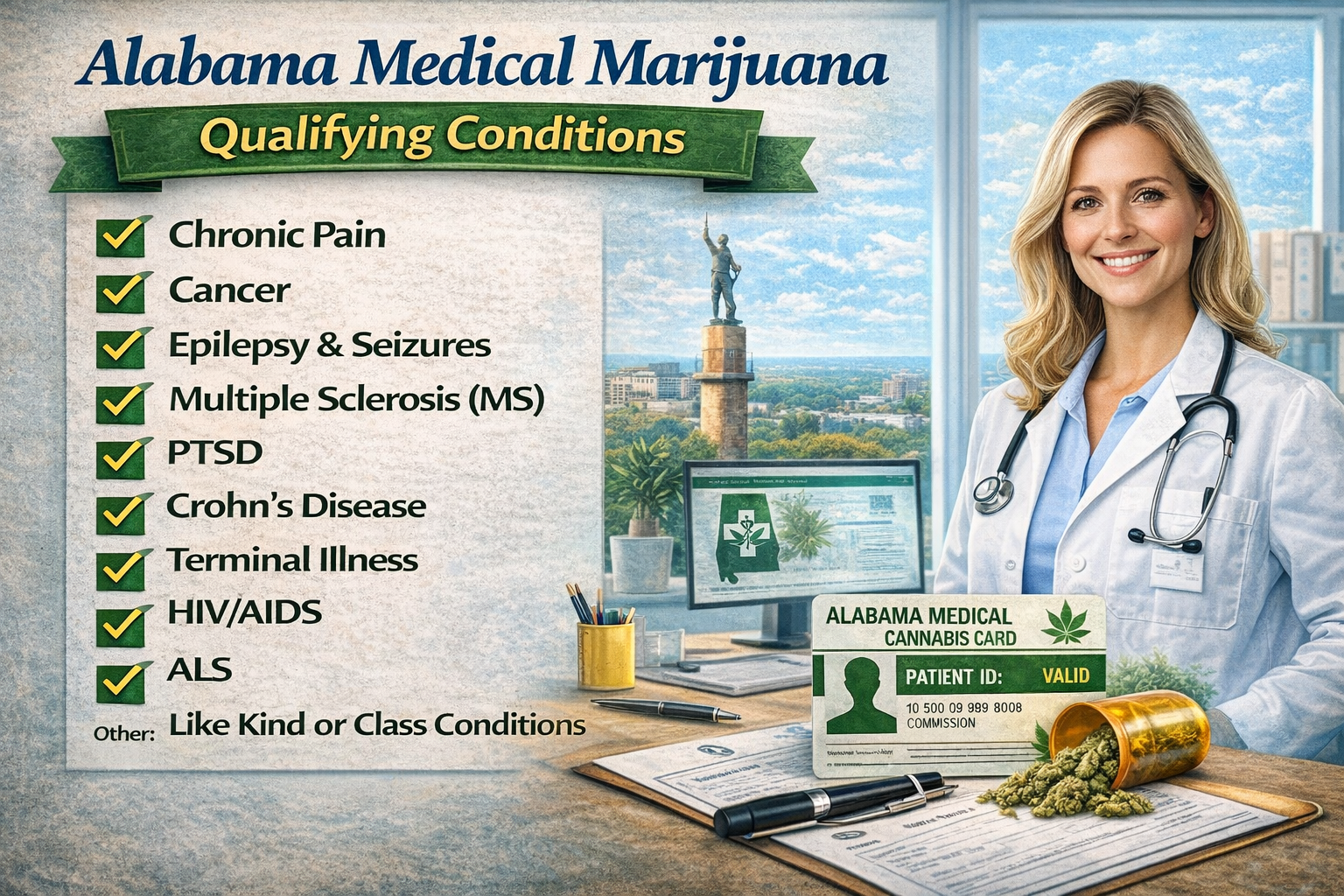
Alabama Medical Marijuana Qualifying Conditions Explained
Alabama’s medical marijuana program has opened new treatment options for patients living with serious and chronic medical conditions. While medical cannabis is legal in Alabama under specific regulations, not everyone automatically qualifies. Understanding which conditions are approved—and how eligibility is determined—is essential before scheduling an evaluation.
This guide explains Alabama medical marijuana qualifying conditions, how doctors determine eligibility, and what patients should know before starting the certification process.
Understanding Alabama’s Medical Marijuana Program
Alabama legalized medical marijuana through the Darren Wesley “Ato” Hall Compassion Act. The law allows qualifying patients to access medical cannabis with a physician certification from a licensed, registered provider. Unlike recreational marijuana states, Alabama’s program is highly regulated and strictly medical.
Oversight of the program is handled by the Alabama Medical Cannabis Commission (AMCC), which establishes rules for physicians, products, and patient access. You can review official program details directly from the state here: https://amcc.alabama.gov/
Only patients diagnosed with approved conditions—and certified by a registered physician—may legally participate in the program.
How Qualifying Conditions Are Determined
Qualifying conditions in Alabama are defined by law, but eligibility is not automatic. A medical marijuana doctor must evaluate each patient individually. Physicians consider:
- Your diagnosed medical condition
- Severity and duration of symptoms
- Prior treatments and response
- Whether medical cannabis may provide therapeutic benefit
Even if a condition appears on the approved list, a doctor must still determine that cannabis is appropriate for your care.
Approved Medical Marijuana Qualifying Conditions in Alabama
Below are many of the recognized qualifying conditions under Alabama’s medical cannabis law. This list is not exhaustive, and eligibility decisions are always made by a physician.
Chronic Pain
One of the most common qualifying conditions, chronic pain may be related to injuries, nerve damage, arthritis, or long-term illnesses. Cannabis may be considered when pain is severe and other treatments have not provided adequate relief.
Cancer
Patients with cancer may qualify, especially when experiencing symptoms such as pain, nausea, appetite loss, or treatment-related side effects. Medical cannabis is often explored as a supportive therapy alongside traditional care.
Epilepsy and Seizure Disorders
Alabama allows medical marijuana for patients with epilepsy or other seizure-related conditions, particularly when seizures are treatment-resistant. Research has shown cannabinoids may help reduce seizure frequency in some patients.
For peer-reviewed research on cannabis and seizure disorders, visit the National Institutes of Health (NIH): https://www.ncbi.nlm.nih.gov/
Multiple Sclerosis (MS)
Patients with MS may qualify due to symptoms such as muscle spasms, pain, and mobility issues. Cannabis has been studied for its potential role in managing spasticity and discomfort related to MS.
Post-Traumatic Stress Disorder (PTSD)
PTSD is a recognized qualifying condition in Alabama. Physicians may consider cannabis for patients experiencing severe anxiety, sleep disturbances, or trauma-related symptoms when appropriate.
Crohn’s Disease and Other Gastrointestinal Disorders
Inflammatory bowel diseases such as Crohn’s disease may qualify due to chronic inflammation, pain, nausea, and appetite loss.
For clinical insight into digestive conditions and symptom management, refer to Mayo Clinic’s medical resources: https://www.mayoclinic.org/
Terminal Illness
Patients diagnosed with a terminal illness may qualify for medical marijuana to address pain, nausea, anxiety, or appetite issues. In these cases, cannabis may be used as part of palliative or supportive care.
HIV/AIDS
HIV and AIDS are recognized qualifying conditions, often due to associated pain, nausea, wasting syndrome, and other chronic symptoms.
Amyotrophic Lateral Sclerosis (ALS)
ALS patients may qualify due to muscle spasticity, pain, and neurological symptoms associated with the condition.
Conditions of “Like Kind or Class”
Alabama law also allows physicians to recommend medical marijuana for other diagnosable conditions of like kind or class. This means that if your condition is similar in severity or impact to an approved diagnosis, a physician may consider you eligible.
This provision gives doctors discretion to help patients with serious conditions not explicitly listed in statute—provided the medical rationale supports cannabis use.
What Conditions Do Not Qualify Automatically
It’s important to understand that minor or short-term conditions typically do not qualify. General stress, mild anxiety, or temporary pain alone may not meet eligibility standards without a qualifying diagnosis and documented medical history.
A licensed medical marijuana doctor will explain whether your condition meets Alabama’s requirements during your evaluation.
Medical Documentation and Evaluation
To determine eligibility, doctors may request:
- Medical records or prior diagnoses
- Prescription history
- Imaging or test results (if applicable)
- Symptom descriptions and treatment history
The evaluation process is confidential and designed to ensure patient safety and legal compliance.
Role of the Alabama Department of Public Health
Once certified, patients must complete state registration steps as required. The Alabama Department of Public Health (ADPH) plays a role in public health oversight related to medical cannabis.
Official public health guidance can be found here: https://www.alabamapublichealth.gov/
Why Seeing a Licensed Medical Marijuana Doctor Matters
Only physicians registered with Alabama’s medical cannabis program may issue certifications. These doctors understand:
- State eligibility rules
- Documentation standards
- Certification and renewal requirements
- Patient responsibilities under Alabama law
Using unverified providers or misinformation can delay or invalidate your certification.
Final Thoughts
Alabama’s medical marijuana program is designed to help patients with serious, chronic, and debilitating conditions access cannabis safely and legally. Understanding the qualifying conditions is the first step—but eligibility is always determined by a licensed physician through a proper medical evaluation.
If you believe medical marijuana may be right for you, the next step is speaking with a qualified provider who can review your condition, answer your questions, and guide you through the certification process.
Medical cannabis is not a one-size-fits-all solution—but for many Alabama patients, it offers a valuable option when other treatments have fallen short.