
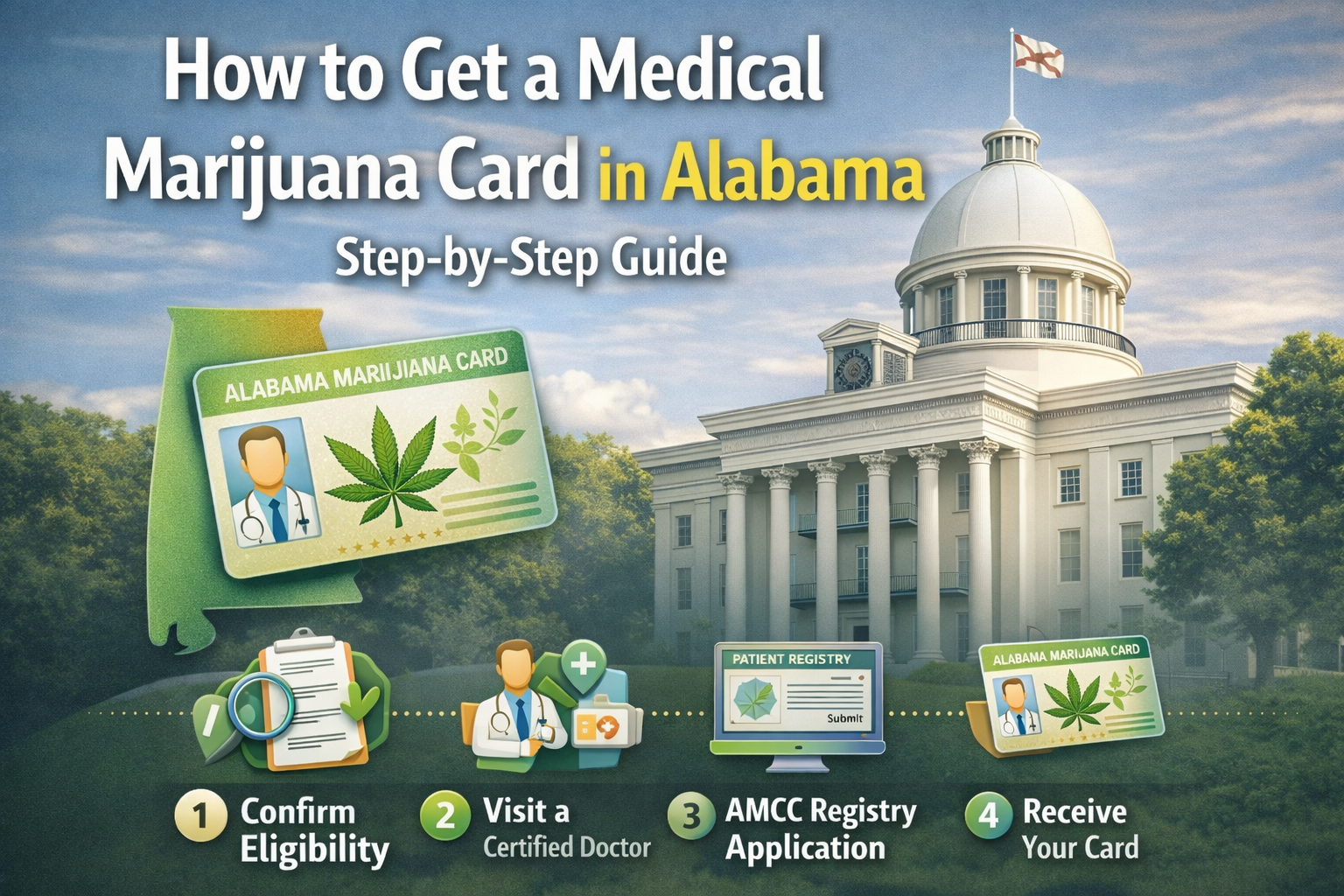
How to Get a Medical Marijuana Card in Alabama: Step-by-Step Guide
If you’re trying to get legal access to medical cannabis in Alabama, the process is straightforward once you understand the order of operations: qualify → see a certified physician → get entered into the state registry → complete your patient application → receive your card. Alabama’s program is overseen by the Alabama Medical Cannabis Commission (AMCC), and the patient card is tied to the state’s registry system.
This guide walks you through each step—without making it complicated—and includes what you’ll need, what it may cost, and common mistakes to avoid.
Step 1) Confirm you meet the basic eligibility requirements
To apply for a medical cannabis card in Alabama, you must generally:
- Be an Alabama resident
- Be 19+, or have a parent/legal guardian act as your registered caregiver if you’re under 19
- Have a qualifying medical condition
- Receive a recommendation from an Alabama physician certified to recommend medical cannabis
- Be registered in the AMCC patient registry system
This is the baseline. The next steps are about proving you qualify and getting your information into the registry correctly.
Step 2) Check whether your condition is on Alabama’s qualifying list
Alabama limits medical cannabis recommendations to specific qualifying conditions. The AMCC lists conditions such as Autism Spectrum Disorder, cancer-related symptoms (including chronic pain), Crohn’s Disease, depression, epilepsy/seizure disorders, HIV/AIDS-related nausea/weight loss, panic disorder, Parkinson’s Disease, persistent nausea (not pregnancy-related), PTSD, sickle cell anemia, spasticity (e.g., MS/spinal cord injury), terminal illness, Tourette’s, and certain chronic/intractable pain situations.
Practical tip: If you’re not sure whether your situation fits, gather documentation anyway (next step). A qualified certifying physician will determine whether you meet the criteria and whether medical cannabis is appropriate for your case.
Step 3) Gather the documents you’ll need before you book your appointment
Most delays happen because people show up without the basics. Get these ready:
Identity & residency
- Alabama driver’s license or state ID (or other proof of residency)
Medical documentation
- A diagnosis record, visit notes, or supporting documentation related to your qualifying condition
- A medication list (what you’ve tried and what didn’t work)
Caregiver documents (if applicable)
- If you’re under 19, your parent/legal guardian must serve as caregiver
- If you’re 19+, Alabama allows certain family/authorized individuals to act as caregiver (e.g., parent, legal guardian, grandparent, spouse, or healthcare power of attorney)
Step 4) Book an evaluation with a certified Alabama medical cannabis physician
In Alabama, the recommendation must come from a physician who is properly approved to recommend medical cannabis under the state’s rules. The Alabama Board of Medical Examiners (ALBME) describes the physician permit process and requirements (including training and rules physicians must follow).
Important expectation: Alabama’s rules include an in-person physician-patient relationship requirement, and ALBME guidance indicates physicians are prohibited from using telemedicine for certification/recommendation.
If you want a simple starting point for finding an Alabama-focused clinic workflow and next steps, you can begin here:
- Marijuana Card Alabama: Alabama Medical Marijuana Doctors
- Alabama Marijuana Doctor Locations: View Alabama locations
Step 5) Complete your exam and receive a physician recommendation
During the visit, the physician will review your history, evaluate your condition, and decide whether medical cannabis is appropriate. If they recommend it, they will enter the required information into the AMCC patient registry system, which is what makes you eligible to submit your patient registration and card application.
This is a key point: you don’t “self-apply” first. The physician entry into the registry is what unlocks your ability to apply.
Step 6) Apply for your Alabama medical cannabis card through the AMCC registry process
Once the physician enters your recommendation into the registry system, you complete your patient registration/card application as instructed by AMCC.
You’ll typically:
- Create your patient account/profile (as directed by AMCC portal instructions)
- Complete the patient application fields carefully
- Pay the applicable state fee (see next step)
- Submit and monitor for updates
Avoid this common mistake: Don’t rush the profile details. Name, DOB, and ID details should match your documents. Small mismatches can cause unnecessary delays.
Step 7) Pay the state fee and understand renewal/replacement costs
AMCC publishes a fee schedule for patient/caregiver cards. Current listed fees include:
- Patient registration application fee: $50 (physical card) / $40 (virtual card)
- Annual renewal fee: $50 (physical) / $40 (virtual)
- Replacement fee: $25 (physical) / $20 (virtual)
Fees can change over time, so always confirm on AMCC’s site before submitting.
resource #1: AMCC Schedule of Fees (PDF)
Step 8) Know what products are allowed (and what’s not)
A lot of people assume “medical marijuana” automatically means flower or vaping. Alabama’s allowed product forms are specific. AMCC lists permitted options like tablets, capsules, tinctures, topicals, suppositories, transdermal patches, nebulizers, and liquids/oils for inhalers, while prohibiting raw plant material and products that could be smoked or vaped, as well as typical “food” edibles like cookies or candies.
This matters because it sets expectations for what you’ll be able to purchase once dispensaries are operating near you.
Step 9) After you’re approved: where to buy and what to expect about availability
Once you have an active card and Alabama dispensaries are open and stocked, you can purchase through licensed dispensing sites.
AMCC has published status updates on dispensary licensing and lists several municipalities where dispensing sites are expected based on licenses issued. AMCC also notes key dates (including awards/issuance actions in late 2025 and early 2026).
resource #2: AMCC Patients & Caregivers page (status + steps)
Step 10) Renew on time (so you don’t lose access)
Your card isn’t a one-and-done item. Renewal is part of staying active, and a lapse can interrupt your ability to purchase until everything is current again. The AMCC fee schedule also includes annual renewal fees.
Quick checklist: the fastest path to approval
- ✅ Confirm you meet Alabama’s resident/age rules
- ✅ Verify you have a qualifying condition
- ✅ Gather medical documentation + Alabama ID
- ✅ Schedule an in-person evaluation with a properly certified physician
- ✅ Physician enters you into the AMCC registry
- ✅ Complete your patient application + pay the state fee