
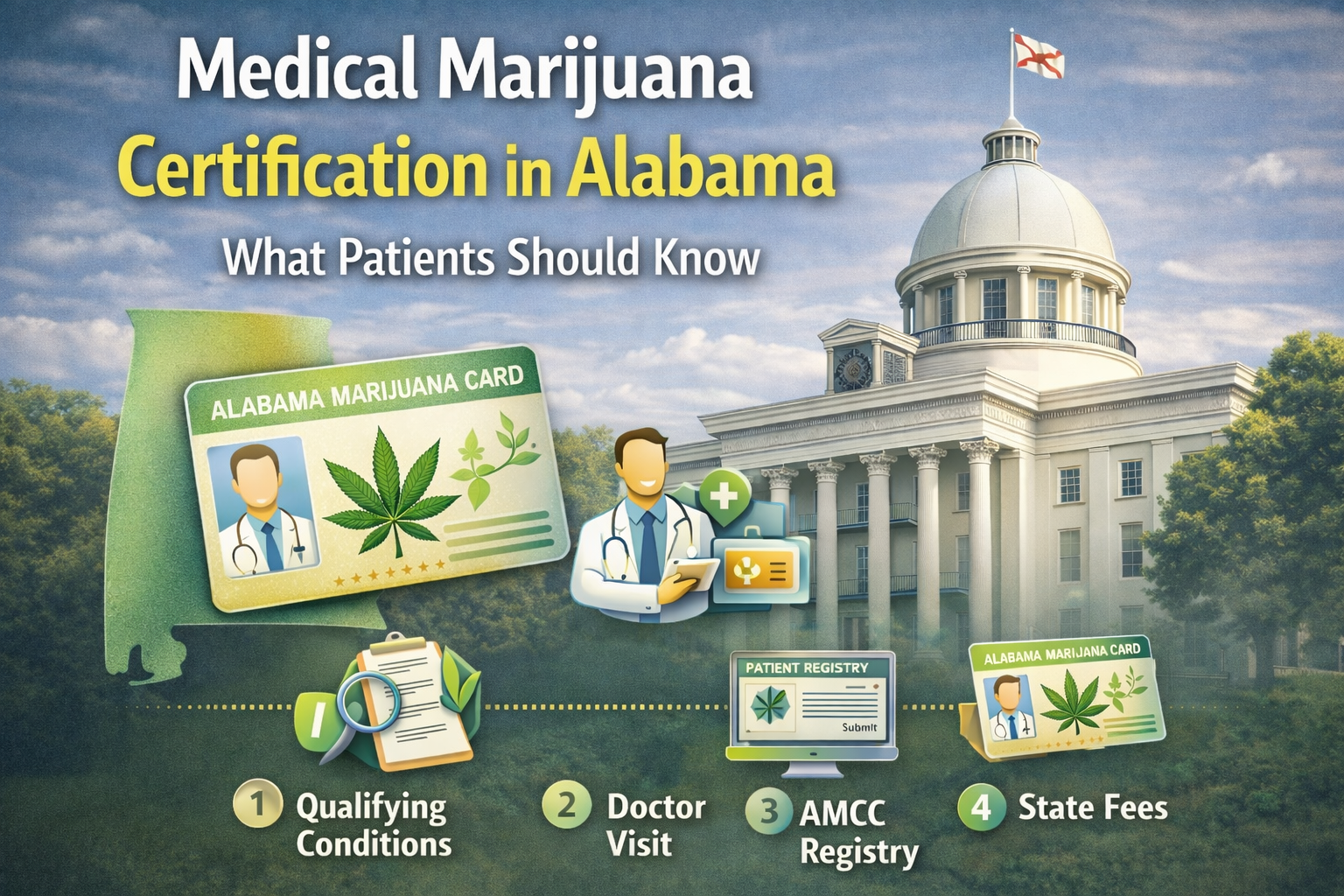
Medical Marijuana Certification in Alabama: What Patients Should Know
If you’ve been hearing that Alabama’s medical cannabis program is finally moving forward, you’re not alone. For patients, the most important piece to understand is the certification process—how you go from “I think I qualify” to having an active patient registration and, eventually, an Alabama marijuana card you can use when products are available.
This guide explains what “certification” really means in Alabama, what you’ll need for your appointment, what the state registry step looks like, and the common mistakes that slow people down—without overcomplicating the process.
What “certification” means in Alabama (and why it matters)
In Alabama, patients don’t simply apply on their own and get approved. The process hinges on a registered certifying physician. If the physician determines you have a qualifying condition and recommends medical cannabis, the physician enters your information and recommendation into the state’s patient registry system. Only then are you eligible to complete the patient registration and apply for a medical cannabis card through the AMCC portal.
This is the core workflow behind Alabama Medical Marijuana Cards:
Qualify → physician evaluation → physician enters you into the registry → patient completes registration/card application.
Who qualifies for certification?
Alabama limits medical cannabis recommendations to specific qualifying medical conditions. The Alabama Medical Cannabis Commission lists qualifying conditions such as Autism, cancer-related symptoms (including chronic pain), Crohn’s, depression, epilepsy/seizure disorders, HIV/AIDS-related nausea/weight loss, panic disorder, Parkinson’s, persistent nausea (with exceptions), PTSD, sickle cell, spasticity (including ALS/MS/spinal cord injuries), terminal illness, and Tourette’s.
Key point: Having a condition on the list doesn’t automatically mean you’ll be recommended. The physician still has to assess your medical history, current symptoms, and whether medical cannabis is appropriate and safe for you.
Outbound link #1 (qualifying conditions):
AMCC – What conditions qualify for medical cannabis treatment?
What to expect at your certification appointment
A certification visit in Alabama is a real medical evaluation—not a quick formality. Your physician will typically review:
- Your diagnosis and symptom history
- Treatments you’ve tried (medications, therapies, outcomes)
- Contraindications and safety considerations
- Whether your condition aligns with Alabama’s qualifying list
- Whether medical cannabis is a reasonable option for your situation
The Alabama Board of Medical Examiners (ALBME) outlines the medical cannabis registration framework for physicians and includes the qualifying conditions established by statute.
Outbound link #2 (physician framework / qualifying conditions):
ALBME – Medical Cannabis (physician registration info)
Can you get certified by telemedicine in Alabama?
This is a major source of confusion. Under Alabama’s medical cannabis rules, registered certifying physicians are prohibited from using telemedicine when certifying or recommending a patient (and related examinations).
In plain English: plan on an in-person visit for certification.
Outbound link #3 (telemedicine prohibition rule text):
AL Admin Code filing – Rule 540-X-25-.09 (telemedicine prohibited)
What documents should you bring?
To keep your visit smooth (and avoid delays), prepare:
1) Proof of identity + Alabama residency
- Alabama driver’s license or state ID (or equivalent acceptable documentation)
2) Medical documentation
- A record showing your diagnosis (visit notes, diagnosis letter, specialist documentation, etc.)
- Medication list and what you’ve tried already
- Any relevant imaging/lab summaries (if applicable)
3) Caregiver documentation (if needed)
- Alabama has caregiver pathways (especially important for minors and some adults). The AMCC patient resources explain how the patient registry process works for patients and caregivers.
What happens after the physician recommends you?
This is where Alabama’s process is different from what people expect.
If the physician recommends medical cannabis, the physician enters the patient’s information and recommendation into the patient registry system, and then the patient becomes eligible to complete the patient registration and apply for the card through the AMCC portal instructions.
Outbound link #4 (patient registry process):
AMCC – Patients (registry process + portal instructions)
Fees: what patients should budget for
Costs can include:
- Your medical evaluation visit fee (set by the clinic/physician)
- State fees for the card/registration and renewals
AMCC publishes a schedule of fees (including patient and caregiver fees, renewals, and replacement fees). A revised version was published in late 2024 (posted in 2025) and still shows common patient/caregiver annual renewal fees (physical vs virtual) and replacement fees.
If you want the official document, use the AMCC fees PDF here:
AMCC – Schedule of Fees, Penalties & Fines (PDF)
(That’s a helpful reference for state fees; your clinic visit cost is separate.)
Timing: when will Alabama patients be able to purchase?
Licensing and rollout timelines have faced delays, but recent reporting indicates the program has been moving toward product availability in spring 2026, with steps including physician certification and establishing the patient registry process.
The practical takeaway: Certification and registry readiness matter now—because once dispensaries are operational, patients who are already properly registered will have the easiest path to access.
Common mistakes that slow down approval
1) Showing up without medical records
If you don’t bring documentation, you may need an extra appointment or records request.
2) Assuming you can do everything online
Because telemedicine certification is prohibited, in-person evaluation matters.
3) Expecting the state to approve you before a physician visit
In Alabama, the physician’s registry entry is what makes you eligible to complete the patient registration step.
4) Not understanding product form limits
Alabama’s permitted product forms are specific (and different from many states). Reviewing AMCC guidance helps set expectations.
What to do next if you’re ready
Here’s the clean “next steps” checklist:
- Review Alabama’s qualifying conditions and confirm you likely fit.
- Gather your medical documentation and Alabama ID.
- Schedule an in-person evaluation with a registered certifying physician.
- If recommended, complete your patient registration through AMCC’s portal instructions after the physician enters you into the registry.
- Keep an eye on renewal timing and fees so your card stays active.
If you’re writing this for your website, you can naturally include the phrases Alabama marijuana card and Alabama Medical Marijuana Cards a couple of times like this—without repeating them in every paragraph. The goal is clarity for patients first; SEO follows.